-
Title
-
Analysis of Patio 29 arpillera
-
extracted text
-
Tash Gauerke
Dr. Strunk
GEOG 331
10 April 2026
Revised Arpillera Analysis
Chilean arpilleras are much more than handwoven tapestries that tell stories. They
represent the specific timeline from 1973-1989, when Augusto Pinochet overthrew Salvador
Allende in a military coup that lasted 17 years. These textiles demonstrate perseverance
throughout a military dictatorship, protest as a form of resistance, women’s roles in social
movements, and grief faced by women whose families were “disappeared.” Not only were
arpilleras visual testimonies of violence, hunger, unemployment and military repression, but they
were also economic lifelines, as selling arpilleras helped families of the disappeared survive
(Agosin, 1987, p. 93).
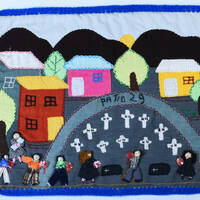
The arpillera I analyzed (pictured below) has many aspects that display the social and
geographical context of Chile during the 1973-1990 Pinochet dictatorship. The most obvious
feature is the bright colors of fabric used to make the houses in the arpillera. These sewn fabrics
had symbolic and emotional meaning, as they belonged to the disappeared or deceased loved
ones. Another characteristic of this arpillera is the Andes Mountains and sun in the background.
This is sewn into almost every textile we analyzed in the CVC. Arpilleras tend to recreate
landscapes controlled by Pinochet, emphasizing details like neighborhood raids, street protests,
public squares, and rural landscapes. These areas depicted in the tapestries are not neutral, but
rather a representation of political spaces tied to poverty, displacement, or military disturbance
(Bacic, 2010, p. 393-394).
�A specific place in the arpillera is a giant graveyard that reads “Patio 29.” It refers to a
memorial site in Santiago where murdered Chileans were buried during the dictatorship. It
became an important site for truth-seeking when the country was recovering from Pinochet’s rule
and heading toward democracy (Devisser et al., 2014, p. 216). Patio 29 was considered a national
symbol for public memory that embodies the fight for truth. It was places like Patio 29 that had
impacts on the National Truth and Reconciliation Commission, which worked with limited
power to investigate human rights violations after the dictatorship under President Alwyn
starting in 1990 (Devisser et al., 2014, p. 222).
In March of 1974, the first arpillera workshops were formed across church basements in
Santiago and sponsored by the Vicariate of Solidarity, a human-rights organization created by the
Catholic Church (Agosin, 1996, p. 11-12). Here, women were not only able to unite by their
grief, but demonstrate collective resistance by coming together in sisterhood to negate the
masculine authoritarian oppression and exploitation caused by the Pinochet regime.
An overall theme in this arpillera and most others is women as political activists. Many
were not politically affiliated prior to Pinochet’s abuse of power, and their lives revolved around
the home (Agosin, 1996, p. 10). Mothers of the disappeared used their domestic skills, like
sewing and embroidery, to their advantage to create a safer method of protesting that was
difficult to track down (Bacic, 2010, p. 394). In the chosen arpillera, we can see women holding
objects that are most likely made of plastic. These represent “cacerolazos”, the banging of pots
and pans to protest both Allende and Pinochet. This method is still used in Chile today, and is a
prime example of maternal activism.
During the dictatorship, arpilleras were smuggled out of Chile and sold internationally,
which linked Chilean women to various churches, NGOs, and human rights groups (Bacic, 2010,
p. 405). The globalization of arpilleras helped spread awareness about the effects of the
dictatorship, especially to parts of Europe. It also provided a source of income for women who
�were struggling financially during the disappearance of their sons and husbands (Bacic, 2010, p.
396).
To conclude, Chilean arpilleras transitioned from individual to collective activism, when
women came together to weave textiles as a form of protest and grief during the 17 year
dictatorship. The landscapes that are depicted in the arpilleras are geographically important to the
time period and are all real events that occurred on the streets of Santiago, such as “cacerolazos”
and Patio 29. The arpilleras not only tell stories, but represent much deeper emotions associated
with a unique way to protest: through art.
�Works Cited
Agosin, M. (1987). Scraps of life: Chilean arpilleras. Red Sea Press.
Agosin, M. (1996). Threads of love. University of New Mexico Press.
Bacic, R. (2010). Arpilleras in contested spaces. Journal of Cloth and Culture, 8(3), 391-411.
Devisser, E., Latham, K., & Intriago Leiva, M. (2014). The contribution of forensic anthropology
to national identity in Chile: a case study from Patio 29. Cambridge University Press.
https://www.researchgate.net/profile/Elizabeth-Devisser-2/publication/298189394_The_c
ontribution_of_forensic_anthropology_to_national_identity_in_Chile_a_case_study_fro
m_the_Patio_29_mass_grave/links/5eda5a80299bf1c67d41d4ee/The-contribution-of-fore
nsic-anthropology-to-national-identity-in-Chile-a-case-study-from-the-Patio-29-mass-gra
ve.pdf
�
The arpillera I chose to analyze has a deep blue woven border with a dark rendition of
the Andes mountains with the sun shining from the background, casting light on what appears to
be a funeral, attended solely by women, their clothes often made from scraps of clothing textiles
likely from disappeared loved ones. They hold plastic flowers as they surround two coffins in a
field of gravestone crosses. Above them sits an arch, “patio 29”, a mass grave site and
monument to those who were silenced and disappeared during the military dictatorship. “NN”
echeted into all grave stones, “no name” an echo of the lack of closure surrounding the status of
the disappeared. Beyond the gravesite sits the city of Santiago, home of the patio 29
monument, situated within the Andes mountains, the numerous houses made from a colorful
series of fabrics with reds, pinks, and yellows strewn across the landscape.
In the artists rendition of the everyday life experienced by chilean women, this piece of
art depicts the lived experiences of numerous individuals who are within the military dictatorship,
were forced to live without closure as to the whereabouts of the disappeared, closure that is still
unacknowledged by the current Chilean government; shaping current political resistance and
human rights advocacy for modern day activists. The disappearances conducted by the
Pinochet dictatorship after the Sept 11th coup and his subsequent installation as leader of Chile;
were often men; the primary victims of political violence, subject to torture and execution. The
extent of political violence, a grief which caused Chilean women to take the lead in the fight
against the military dictatorship by occupying public memory and reclaiming their history,
sharing their art in large numbers, another tactic of resistance, an elusive use of a gendered
system of labor which utilized culturally significant uses of textiles to express their lived
experiences and history in visual medium able to speak volumes years after the dictatorship.
These textiles serve to tell the stories of the marginalized, voices often left out of historic
narratives; giving a voice to the disproportionately silenced.
�In a larger geopolitical context, arpilleras represent a historically culturally significant use
of textiles and weaving as a means of individual and collective resistance during the Pinochet
dictatorship. Life as it was before the military dictatorship will never be the same, during it
however, women who came together in support of one another built new communities of trust
and mutual aid, echoing the fight against authoritarianism still felt by the working class people of
the world today. Women took over work, teaching one another skills which will be useful in the
creation of these pieces of art but also community building at a much larger scale, improving
trust and communication by building bonds amongst the members of the community; these
textile practices having a long historical precedent as an act of resistance in the Latin American
region and across the world.
The materials used to make this Arpillera, and many others, were more likely than not
made from material that was readily available along with significant articles of clothing from the
disappeared; collective and individual creation of these pieces reflecting the community
members that came together to document their stories and history. This can be seen as a
powerful form of collective resistance; utilizing materials on hand shaped by the current
economic hardship.
�
 Patio 29