Analysis of Villa Grimaldi arpillera
Item
-
Title
-
Analysis of Villa Grimaldi arpillera
-
extracted text
-
Woods 1
Revised arpillera analysis
“Repression at Villa Grimaldi: One of the Concentration Camps” arpillera
By: Amiyah Woods
Arpilleras are textiles made from burlap fabric that were used to tell stories about life in
Chile during the military dictatorship of Augusto Pinochet. The word “arpillera” refers to the
rough burlap cloth that many of these pieces were made on. Women used these textiles to show
what was happening in their communities, especially the disappearances of loved ones and the
violence carried out by the government. Instead of writing their stories, they stitched them into
fabric.
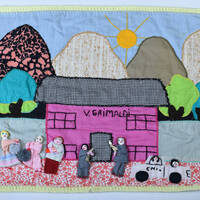
“Repression at Villa Grimaldi: One of the Concentration Camps”, an arpillera from
Augustana’s collection shows a scene outside a place labeled “V. Grimaldi.” At first, it looks
kind of simple and almost peaceful. There is a bright pink house, trees, mountains, a sun, and
small people standing around in what looks like everyday life. But after looking closer, I realized
it is actually showing something much more serious. The “V. Grimaldi” label refers to Villa
Grimaldi, which was one of the main detention and torture centers during the dictatorship.
Thousands of people were taken there, and many were tortured, killed, or disappeared.
What stood out to me most is the contrast between how the scene looks and what it
actually represents. On one hand, the colors are really bright, especially the pink house and green
trees, so it almost feels normal or even happy at first glance. On the other hand, knowing what
Villa Grimaldi actually was changes everything. Because of this, it shows how violence was
happening in places that could still look like regular neighborhoods on the outside. Overall, life
in Santiago wasn’t always visibly chaotic, but people were still living with fear, loss, and
uncertainty.
In addition, the people in the scene made me think more about that. Some of them look
like they are standing together or talking, like they could be waiting for something or trying to
get information. This reminded me of families who would go outside places like Villa Grimaldi
hoping to find out what happened to their loved ones. Unfortunately, a lot of the time, they never
got answers. Inside places like this, prisoners were tortured and often disappeared completely. As
I read in the sources about Villa Grimaldi, people were held in tiny cells, beaten, shocked with
electricity, and in many cases killed and hidden so there was no trace left.
Furthermore, the background with the mountains and trees also feels important. It shows
the landscape of Chile and helps ground the scene in a real place, not just an idea. Even though
the dictatorship caused so much violence, the natural landscape stayed the same. As a result, the
mountains especially make it feel like life kept going in the background, even when so much was
happening to people in the city.
At the same time, this arpillera also connects to the idea of memory. Even though Villa
Grimaldi looks like just a house in the textile, it was actually a real place where a lot of violence
happened. As Marjorie Agosín explains, arpilleras gave women a way to tell stories that were
being silenced. Instead of those stories disappearing, they were stitched into fabric. Similarly,
�Woods 2
Roberta Bacic points out that these textiles are both art and records of real history, not just
decoration.
In addition, it is important to understand this in terms of women’s movements. A lot of
arpilleras were made in groups of women who met in workshops, often through churches or
human rights groups. Most of them were family members of people who had disappeared.
Because of this, sewing together gave them a way to support each other and talk about what was
happening. It also gave them a way to resist, even if it wasn’t through direct protest.
Beyond Chile, these arpilleras also ended up going into the international world. Many
were sent or smuggled out of the country and shown in other places around the world. As a
result, this helped people outside Chile learn about what was happening during the dictatorship
and built international awareness about human rights abuses.
Overall, this arpillera shows both everyday life and violence at the same time. At first
glance, it looks simple, but in reality, it represents something very heavy. It shows how people
tried to keep living while dealing with fear and loss, and how women used sewing to tell stories
that otherwise might have been erased. In conclusion, the most important part is how it keeps
memory alive. Even though the government tried to hide what happened in places like Villa
Grimaldi, these women still found a way to show the truth through fabric.
�Woods 3
Work Cited:
https://www.peoplesworld.org/article/villa-grimaldi-chile-s-memorial-to-victims-of-torture/
https://english.elpais.com/international/2025-12-12/all-the-horror-of-pinochets-dictatorship-fits-o
n-a-mother-of-pearl-button.html
https://en.wikipedia.org/wiki/Villa_Grimaldi
�
 Villa Grimaldi