No más exilio
Item
-
Title
-
No más exilio
-
Description
-
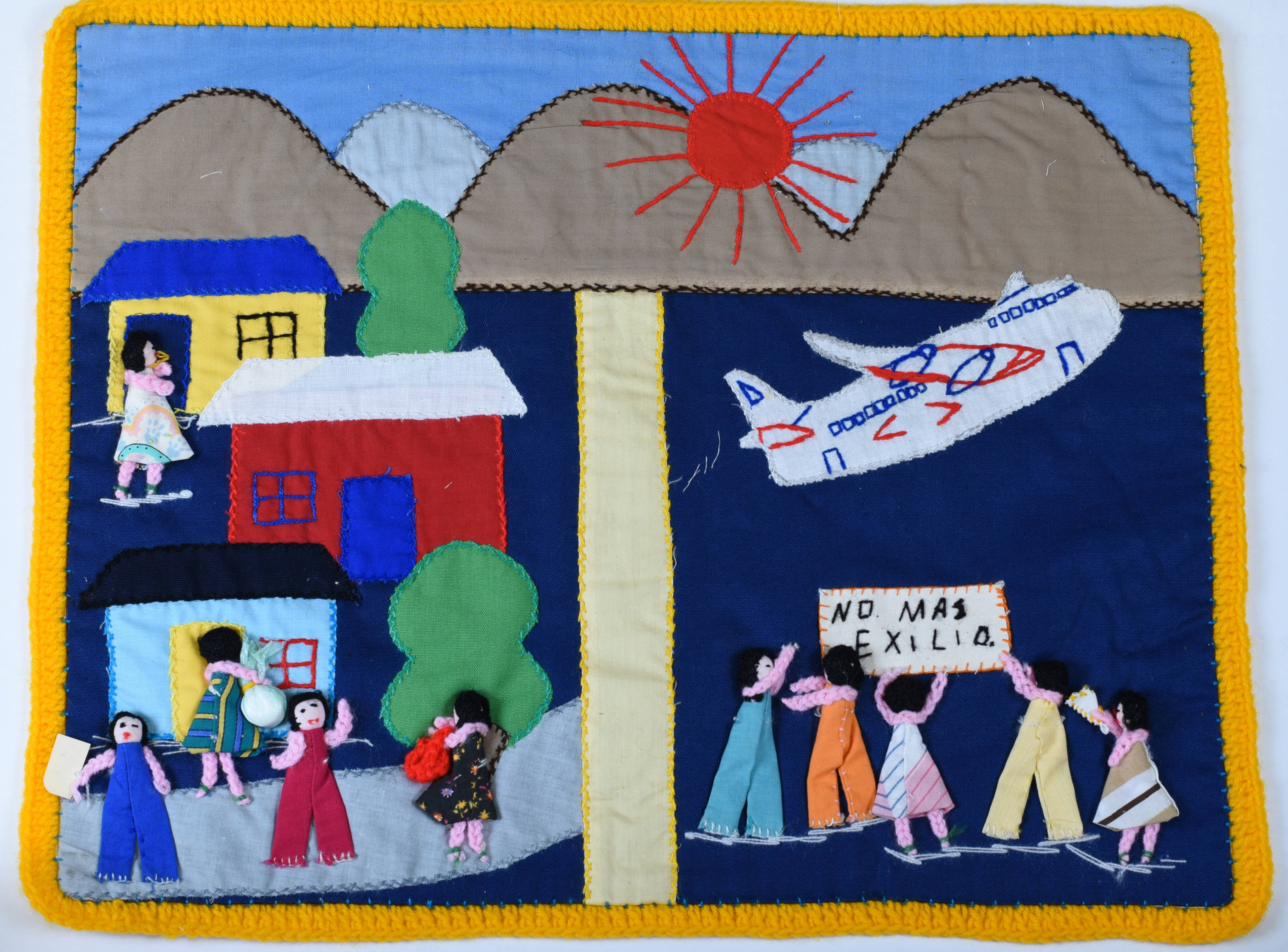
This arpillera has two halves. On the left of the border, there looks to be a lively neighborhood, with trees, and colorful homes. Several people are gathered outdoors in a public space, suggesting an element of everyday community life. The handmade figures made from fabric and yarn carry bags of goods and look to be involved in a conversation, maybe about work, family care, or current events. This half of the arpillera represents home, belonging, and the social fabric of communities before they were torn apart by kidnappings.
Looking at the right side, the tone shifts dramatically. A plane flies above the heads of characters, away from the neighborhood. Below the plane are a group of people all holding the weight of a sign saying “No más exilio,” meaning “no more exile.” The airplane represents the harsh reality of mass deportations, executions, and exiles from the country. In the Pinochet era, many Chileans who were even slightly suspected of not bending their knee to fascism, such as dissidents, intellectuals, union workers, and ordinary people, were forced to leave the country. This represents the history of the Pinochet regime, using deportations, disappearances, and murders to control the way that the Chilean population lived.
There is one background for both sides, showing the Andes mountains and a red sun. This seems to be a coastal town, so the sun is likely rising in the east in this arpillera. I believe this is to represent hope, with the blood red color as a reminder of what has already been lost. Each new sunrise may be a reason to hope, but it also brings with it more death and loss. Pinochet’s brutal military dictatorship in Chile was known for “disappearing” people deemed to be enemies of the state or dangers to their regime. A majority of these people were men, leading women to have to lead more active lives outside the home to provide for their families. Sometimes, people were disappeared by being flown into the ocean and dropped into the water, never to be seen again. The plane in this arpillera has many red demarcations on it, potentially signifying blood and death and showing how planes took people away into the ocean to dispose of them. The women underneath protesting, I believe, are meant to show how people didn’t submit at the time to the authoritarian regime, and that there was resistance. It also goes against the idea that women are weak or too fearful to do anything, showing women risking their lives for what they believe in.
-
Contributor
-
Analysis by Jack Ellis and Will Mitchell
 aug_art_2322_full.jpg