Rio Mapocho
Item
-
Title
-
Rio Mapocho
-
Description
-
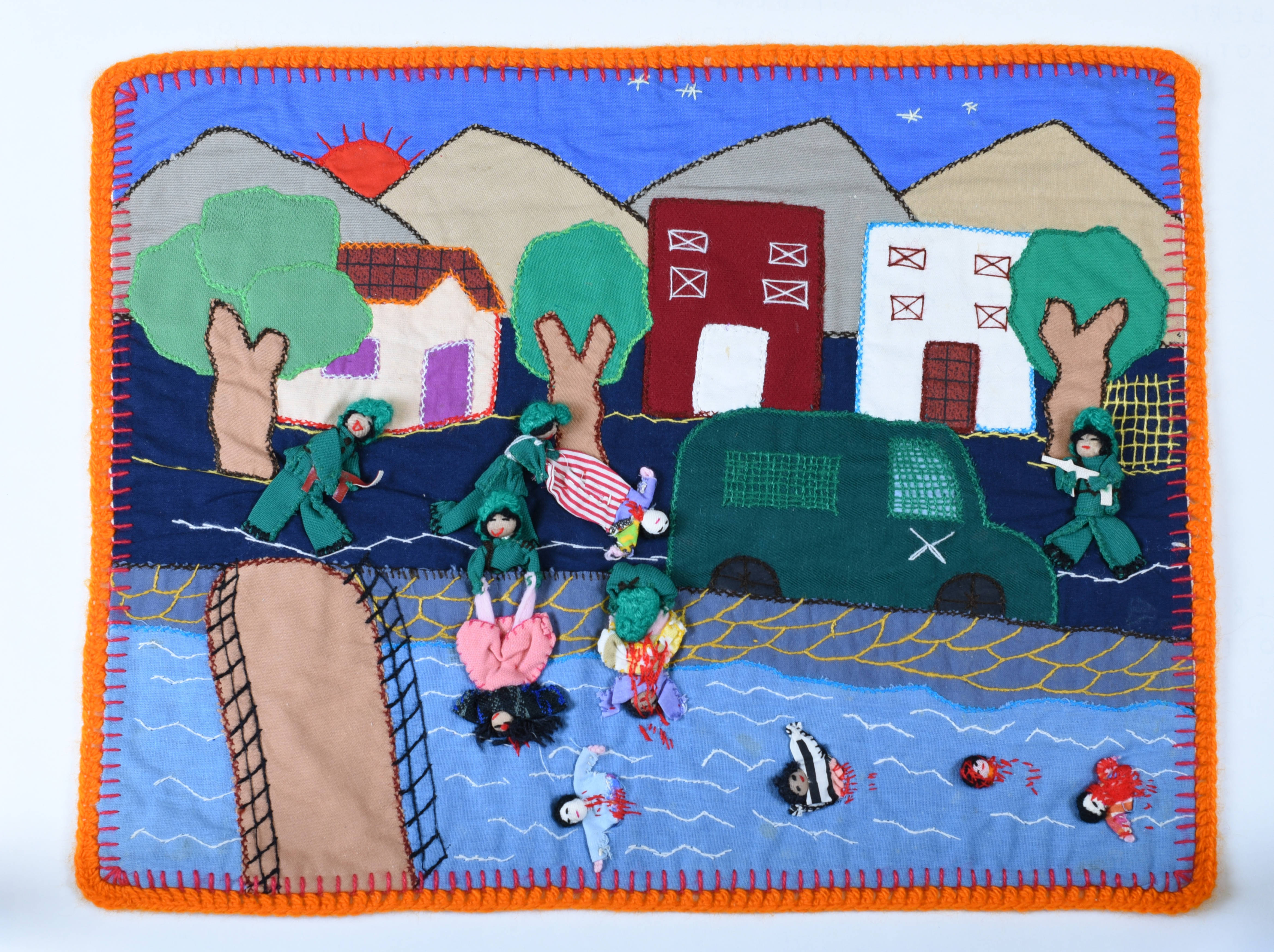
This is a scene of bodies being tossed into the Mapocho River in Santiago. It caught my attention at first due to the horror and pain it elicited in me, but it also showed how Marjorie Agosín’s writing proved true; women could always tell the stories of the days their family members disappeared or were arrested very clearly. To see the memory and reality of the events illustrated in this way, it made it much more real to me and made me feel the shock, disgust and fear at what they witnessed. The way the arpillerista nestled the dead, bloodied men and women inside of the light blue fabric she used to represent their bodies in the river, as if she was tucking them into bed one last time, similarly touched me and made me understand her sorrow, her grief, and her horror.
The technical methods used reflect the hardship that the arpillerista worked with in her depictions of the disappeared. She works with limited materials– pieces of fabric, perhaps from clothing, perhaps from scraps. She uses white thread to depict the movement of the water carrying the bodies west, green thread to show the prison-like interior of the military van. Thick red thread is used to represent the blood of the women, pouring out and pooling in a
way that makes it unmistakable and impossible to miss. In the background there is the common motif of the Andean mountains, though rather than a bright sun such as in other arpilleras, there is a red sun of dusk and the sky blanketed in blue. There are small embroidered stars visible in the sky, watching, but even they appear to be distancing themselves away in fear. Under this cover of night, men in thick green uniforms took pleasure in their activity. The tiny embroidered smile on one of the military men’s faces as he dangled a woman upside down from her feet over the river, looking down her skirt, made me understand the sadistic cruelty at play here. The man to his left leaned over the woman he also held over the river, but with blood flowing from between her legs. It was more than the military men following orders. The underpinnings of sexism, through depictions of rape and cruelty, were present in the small details that the arpillerista took care in adding. It was, is, harrowing.
But in the end we must remember the strength, the integrity, the courage it took this arpillerista to show this event. Despite the trauma and fear she must have felt, she pushed through, slowly creating this art work, thinking and deciding how to construct every element, weaving everything she felt and thought and loved and hated into the fabric.
(Text by Samara Singer)
 Rio Mapocho