Patio 29
Item
-
Title
-
Patio 29
-
Description
-
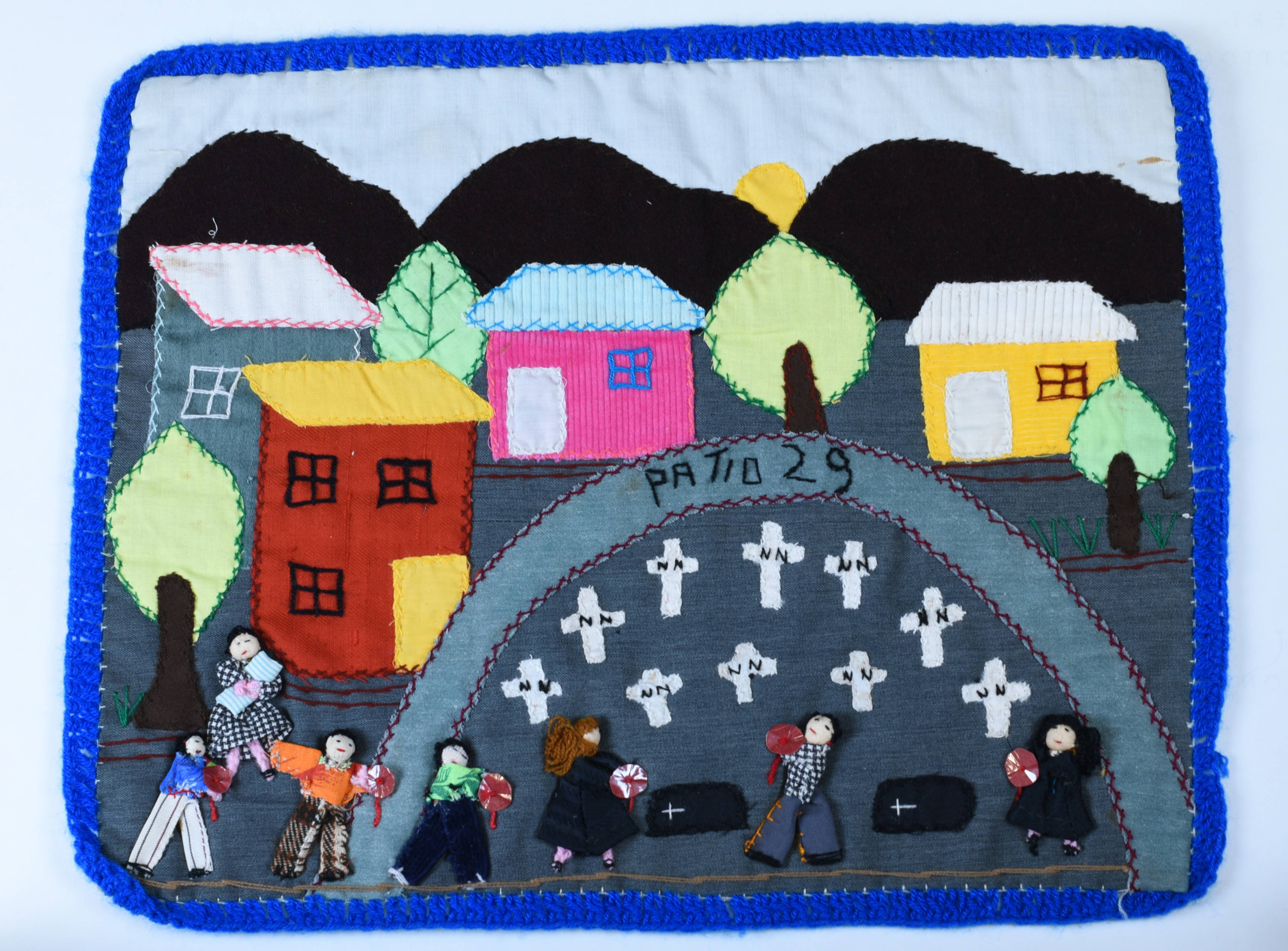
This arpillera has a deep blue woven border with a dark rendition of the Andes mountains with the sun shining from the background, casting light on what appears to be a funeral, attended solely by women, their clothes often made from scraps of clothing textiles likely from disappeared loved ones. They hold plastic flowers as they surround two coffins in a field of gravestone crosses. Above them sits an arch “Patio 29”, a mass grave site and monument to those who were silenced and disappeared during the military dictatorship. The initials “NN” - “no name” - etched into all grave stones are an echo of the lack of closure surrounding the status of the disappeared.
Patio 29 refers to a memorial site in Santiago where murdered Chileans were buried during the dictatorship. It became an important site for truth-seeking when the country was recovering from Pinochet’s rule and heading toward democracy (Devisser et al., 2014, p. 216). Patio 29 was considered a national symbol for public memory that embodies the fight for truth. It was places like Patio 29 that had impacts on the National Truth and Reconciliation Commission, which worked with limited power to investigate human rights violations after the dictatorship under President Alwyn starting in 1990 (Devisser et al., 2014, p. 222).
This arpillera has many aspects that display the social and geographical context of Chile during the 1973-1990 Pinochet dictatorship. The most obvious feature is the bright colors of fabric used to make the houses in the arpillera. These sewn fabrics had symbolic and emotional meaning, as they belonged to the disappeared or deceased loved ones. Another characteristic of this arpillera is the Andes Mountains and sun in the background. This is sewn into almost every arpillera in Center for Visual Culture’s collection. Arpilleras tend to recreate landscapes controlled by Pinochet, emphasizing details like neighborhood raids, street protests, public squares, and rural landscapes. These areas depicted in the tapestries are not neutral, but rather a representation of political spaces tied to poverty, displacement, or military disturbance (Bacic, 2010, p. 393-394).
-
Contributor
-
Analysis by Tash Gauerke and Joren Weller-Vanhollbeke
 aug_art_3298_full.jpg