-
Title
-
Analysis of Rio Mapocho arpillera
-
Contributor
-
Lily Erickson, Leo McRaven, and Samara Singer
-
extracted text
-
Lily Erickson
GEOG 331
Revised Arpillera Analysis
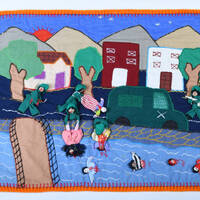
The Arpillera I chose to look at is a scene depicting members of the military
putting men in a river who seem to be bleeding and, if not dead, are suffering. From
what I can tell every soldier in the arpillera has a smile on their face and they seem to
be enjoying what they are doing to these men. This seems to be a very intentional
choice from the artist since their mouths are done with string and are very detailed in
terms of how it was stitched. This could have been done because the artist must have
either seen the reactions from the soldiers when doing things like this or it was the only
way for her to make sense of how someone could possibly do this to another human
being. When looking at the choices of materials used for the arpillera I notice that the
cloth used for everything besides the houses seems to be of a shirt material. The
houses however look to be made of cloth typically seen on pants. There is also a lot of
string used for small details like windows, faces, hair, waves, blood, stars, and the rays
of the sun peeking out over the mountains. This attention to detail is beautiful but at the
same time, horribly sad. The detail of the blood in the river and on the men being
drowned isn't just accidental. It's very deliberately stitched into where the men seem to
have been injured. When looking more at who is in the scene, it looks to be only
soldiers and the bodies that are being thrown into the river. I think that the time of day
being very early in the morning was also intentional since, considering the historical
context, they didn't want people to see what was happening to the people who spoke
�out. They wanted their families to consider them missing and not dead. This is why the
soldiers would do something like this at night rather than during the day when everyone
could see what was happening. Besides the men, there is also a military truck that the
soldiers are taking the bodies out of. The question I still have when looking at this
arpillera is if the men that are bleeding and being put in the river are already dead or, if
they are trying to drown them. Knowing this information feels important since so many
women are left with the thought of not knowing what happened to their loved ones.
�
Arpillera Analysis
The arpillera that I have chosen to analyze depicts the military disposing of people killed by the
regime by dumping them into a river in a remote part of a town. In the background, the Andes
mountains and a setting sun can be seen, possibly depicting the darkness and sadness of the
situation, as the sun is typically thought to represent hope in arpilleras. The Andes may serve
both as a marker of home and to indicate that these horrible atrocities are being committed
within Chile by the Chilean military. The Andes mountains are blocking out the sun, perhaps
indicating that at this time in this place, light cannot break through to the horrific acts being
committed. Many of the bodies being disposed of have been dismembered, and the soldiers
dumping the bodies look like they are smiling. This could serve to convey the lack of remorse
the regime holds for those who it kills in such a brutal fashion. The dismemberment of corpses is
important because it makes identifying victims more difficult, and because it would no doubt
have a much more profound impact on those who come across it. Ultimately, the artwork itself
illustrates the callousness and brutality of the regime and the lack of care from within the
government and military for the citizens which they hold power over.
Pinochet’s dictatorship, along with many similar military bureaucratic dictatorships in South
America, were notorious for their tendency to silently kidnap and dispose of people who could
potentially harbour resentment against the regime regardless of whether or not they really did.
Among the largest targets for “disappearing” were university students, leftist political opponents,
and virtually anyone else publicly critical of the Chilean government. The unprecedented
violence committed by the regime made direct resistance extremely difficult, particularly in the
earlier parts of Pinochet’s regime when violence was far more widespread. Most widespread
protests which did occur within Chile, such as the “Jornadas de Protesta Nacional” in May 1983,
were often met with violent suppression with hundreds killed and injured. During the Dirty War in
Argentina, a movement known as the “Madres de la Plaza de Mayo”, came to prominence by
protesting in extremely high traffic areas so that the government could not quietly disappear the
members of the group, allowing them to bring to light the crimes of the regime without being
properly dispersed.
In Chile however, mothers of the disappeared often looked to foreign human rights
organizations to bring light to the crimes of Pinochet’s dictatorship as opposed to directly
opposing them within Chile. Among the most well known ways this was done was through the
creation of Arpilleras, which would be sold abroad to human rights organizations so that they
may bring awareness of the crimes to the wider geopolitical landscape. Arpilleras were often
made out of burlap, scraps of clothing, and common items, and often depicted either direct
military actions or the consequences of said actions. Arpilleristas were often impoverished, living
in slums in the outskirts of cities such as Santiago. Often, they would covertly express the
sadness and repression which families of the disappeared would face due to having people
taken from them. They served as a new form of language with which to tell the story of the hurt
that had been inflicted upon them as a consequence of the regime’s brutality. Many scraps of
clothing used in Arpilleras came from the wardrobes of the arpillerista’s disappeared children.
�Arpilleras would often be produced en masse in workshops sponsored by the Chilean catholic
church, and then sold abroad so that those who created them could both make a living and call
out for help.
Over the years, many would become exhibits in foreign museums, and transnational human
rights organizations would take notice of the crimes being committed. Groups such as Amnesty
International, AFDD, and the Catholic church itself would bring scrutiny to Pinochet’s regime on
a global scale, pressuring the regime both externally and internally to change its approach. Over
the course of the 70’s and 80’s, more countries would become opposed to the violent South
American regimes, and many of them either became less violent or ended altogether as a
result. On top of bringing widespread criticism of the human rights violations committed by
military dictatorships in the Southern Cone, these Arpilleras also allowed people in other regions
of the world to confront feelings spawning from similar moments in their histories.
�
Samara Singer
Geography of Latin America
Dr. Strunk
April 12th, 2026
Revised Arpillera Analysis
A woman’s physical weakness is something exploited and used against her in many
societies. Many a woman will be forced to submit to the strength and will of men out of fear for
their life, their livelihood, their families, or simply due to the culture she was born into. But
women have an innate strength within them that is not extinguished by brute force. That
strength manifests itself in a variety of ways– her resilience, her ability to hold and pass on
generations of knowledge, her balancing act of managing a home and holding a family together,
the endurance it requires to go on through the mental and physical toll of menses, the ability to
bear the enormous, complicated pain that it takes to grow and birth a child. And on top of this,
she has a powerful and beautiful ability to feel, to inspire, to gather, to hold a community
together, to stoke the flames of justice and passion even in the background, restricted to the
quiet domestic world. This valuable ability is a part of what the Chilean arpilleristas used to
combat the oppressive Pinochet regime, a decades long period of injustice and cruelty that
tested their strength in many ways as it piled on the pain a woman already bears.
Women face a unique position in the political world, particularly in many parts of Latin
America where notions of machismo and patriarchal dominance had restricted women to the
domestic realm. The Pinochet regime positioned men as the main target of the authoritarian
regime, believing men were the only ones who could threaten their authority. This focus is what
allowed the arpilleristas their freedom. Chilean women and some men organized in the
background, attending workshops hosted by the Catholic Church’s Vicariate of Solidarity that
supported them through times of economic difficulty. Over time, these workshops became
progressively more radical– the notion of an arpillera appeared, with women spearheading the
idea. They were pieces of burlap (the literal translation of arpillera) with mixed media layers
such as fabric appliques, plastic, and clothing, with people often represented as small, simple
dolls. They depicted scenes of their life, their pain, their missing loved ones, what they had
seen, and sold them to the Catholic Church every two weeks, providing a modest income for
their families, and spreading their truth throughout the western world. Their art was unique and
a message of resistance and strength, but because sewing was women's work, it was overlooked
by Pinochet’s lackeys.
Their art began modest and hesitant, developing over many renditions and meetings
with fellow arpilleristas. After reading Agosín’s Tapestries of Hope, Threads of Love, especially
the section on “Operation, Staffing, and Training of the Workshops”, I developed a much
greater appreciation for the hard work and development of skills that Chilean arpilleristas
cultivated. The arpilleristas used these skills as a way to protest, tell their stories, and support
themselves. While the arpilleras, on the surface, are very simplistic mixed media scenes, the
knowledge of the constraints placed upon the arpilleristas made me appreciate the arpilleras
much, much more. These women dealt with difficulties in their production from scarcity of
material, to limited work time, to their other commitments at home, such as raising families,
cooking, cleaning, and providing while the men were unable to leave due to fears of
�disappearance– those who had been unlucky had already been disappeared under the cruel
dictatorship, and became the desaparecidos.
The way that the women spoke of their arpilleras over time, from ugly, plain dolls, to
more advanced, cross-stitched canvases, to animated, dynamic scenes of their reality, allowed
me to more deeply understand the hard work at play here; literally, their blood, sweat, tears,
clothes, and hair were stitched into the arpilleras. The way that many women spoke of finding
community and a voice proved to me the strength these women possessed, especially the
woman in the reading who faced beatings at home on top of the oppressive regime that
continued to tear her home and community apart. One quote remains particularly significant;
“they speak a “women’s language” of loyalty, love and outrage; but they speak with a public
anger in a public place in ways they were never meant to do” (30, Agosín). Despite the
difficulties of being born female in a world where one is restricted to the world of domesticity,
powerful and important movements can manifest from the more “feminine” emotions and way
of living.
The particular arpillera that I chose to analyze is the scene of bodies being tossed into
the river. It caught my attention at first due to the horror and pain it elicited in me, but it also
showed how Agosín’s writing proved true; women could always tell the stories of the days their
family members disappeared or were arrested very clearly. To see the memory and reality of the
events illustrated in this way, it made it much more real to me and made me feel the shock,
disgust and fear at what they witnessed. The way the arpillerista nestled the dead, bloodied men
and women inside of the light blue fabric she used to represent their bodies in the river, as if she
was tucking them into bed one last time, similarly touched me and made me understand her
sorrow, her grief, and her horror.
The technical methods used remind me of the hardship that the arpillerista worked with
in her depictions of the disappeared. She works with limited materials– pieces of fabric,
perhaps from clothing, perhaps from scraps. She uses white thread to depict the movement of
the water carrying the bodies west, green thread to show the prison-like interior of the military
van. Thick red thread is used to represent the blood of the women, pouring out and pooling in a
�way that makes it unmistakable and impossible to miss. In the background there is the common
motif of the Andean mountains, though rather than a bright sun such as in other arpilleras, there
is a red sun of dusk and the sky blanketed in blue. There are small embroidered stars visible in
the sky, watching, but even they appear to be distancing themselves away in fear. Under this
cover of night, men in thick green uniforms took pleasure in their activity. The tiny
embroidered smile on one of the military men’s faces as he dangled a woman upside down from
her feet over the river, looking down her skirt, made me understand the sadistic cruelty at play
here. The man to his left leaned over the woman he also held over the river, but with blood
flowing from between her legs. It was more than the military men following orders. The
underpinnings of sexism, through depictions of rape and cruelty, were present in the small
details that the arpillerista took care in adding. It was, is, harrowing.
But in the end we must remember the strength, the integrity, the courage it took this
arpillerista to show this event. Despite the trauma and fear she must have felt, she pushed
through, slowly creating this art work, thinking and deciding how to construct every element,
weaving everything she felt and thought and loved and hated into the fabric. She is not a victim,
but a survivor, and she is the embodiment of women everywhere.
�
 Rio Mapocho