-
[Untitled]
-
 Dr. Gretchen H. Beall
 Taken from the obituary printed in the "Daily Camera"
Born in McLean County, Illinois, Gretchen was the youngest of 6 children. Her father, Howard Hieronymus and mother, Ruth Applegate Hieronymus were musicians as well as enjoying their lives working on the farm. They were active in the community affairs of the closest town, Atlanta. It might be considered unusual that 3 members of the family, Albert, Tom and Gretchen were Emeritus Professors at 3 state universities: University of Iowa, University of Illinois, and University of Colorado. Another brother retired as Lt. Colonel in US Air Force Strategic Air Command. Anne was a high school teacher, and Art continued to work on the family farm. Gretchen attended public schools in McLean and Atlanta, Illinois. She earned the B.A. in Music at the University of Iowa, graduating with high honors. Her master’s degree and doctorate were awarded at the University of Illinois. She taught music in the public schools of Keokuk, Iowa. She then taught at Eastern Illinois University, where she was President of the University Senate. In 1970, she was appointed Associate Professor in the College of Music at the University of Colorado in Boulder, where she continued to teach until her retirement as Emeritus Professor in 1989. She continued to teach on a part time basis, as well as supervising doctoral students for several years. During her time at CU, she was chairman of the Academic Area and the College of Music Faculty Council, as well as several all-University committees. Charles and Gretchen were married on November 7, 1976. After Charles’ retirement from the University of Denver in 1982, they moved to Hygiene where they enjoyed gardening and Mike planted a veritable forest. They moved to Longmont in 1992, where Mike became very active in the Library, the Senior Center and other public affairs. He was proud of the many trees he contributed to the city and to the restoration of wetlands in Indiana, his home state. Gretchen joined him in community activities after her retirement – writing reviews of Longmont Symphony concerts for the Longmont Times-Call, teaching and organizing activities at the Senior Center and participating in the community in many ways with the Longmont Council for the Arts. Gretchen enjoyed her friendships with Longmont citizens of several generations, and she appreciated their intelligence, their love and knowledge of the arts and the larger world, and their capacity for enjoying life and contributing to society.
-
 Dr. Barbara Reeder Lundquist
 From the University of Washington website:
Distinguished music educator Dr. Barbara Reeder Lundquist died in Seattle on August 17, aged 89. Predeceased by beloved late husband Elon H. Lundquist, parents Rev. Ed and Lois Cooke, and sister Karen, Barbara leaves behind many dear friends and relatives.
A native of Hays, Kansas, Barbara earned a BM in cello performance from the University of Wisconsin, an MA at Montana State University, and a Doctor of Musical Arts at the University of Washington. In 1972, she married Elon Lundquist, embracing his family of 6 children. The couple made an excellent team, enjoying 33 years together.
Barbara has been regarded as the "mother of multicultural music education." While teaching in the Seattle Public Schools, she experienced the profound gap between her classical music training and the tumultuous world of inner city students, and developed new paradigms for music education. She raised awareness of the contributions of African music to contemporary culture. She was innovative, direct, thorough, and inclusive. She taught music education and sociomusicology at the University of Washington for many years, retiring as Professor Emerita. She also consulted for numerous national and international organizations, and received awards from the Kennedy Center and the MENC National Black Music Caucus.
Since 2008, Barbara has collaborated with Dr. Kedmon Mapana, now Executive Secretary of Tanzania's National Arts Council, in the establishment of Chamwino Connect as the fundraising arm of the Chamwino Arts Centre. Barbara's efforts have helped maintain its annual Cigogo Music Festival in Tanzania.
-
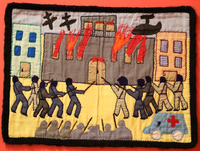 Storming and bombing of the presidential palace, La Moneda, on September 11, 1973.
-
 Documenting disappearances and human rights violations in the Southern Cone
-
 Analysis of Villa Grimaldi arpillera
-
 Analysis of Orange Harvest arpillera
-
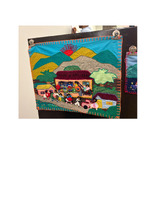 Analysis of Taller de Arpilleras arpillera
-
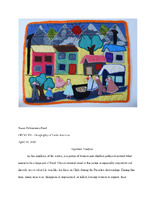 Analysis of Communal Kitchen arpillera
-
 Analysis of Patio 29 arpillera
-
 Analysis of Rio Mapocho arpillera
-
 Analysis of No Más Exilio arpillera
-
 Analysis of Firing Squad arpillera
-
 Analysis of Tanks arpillera
-
 Analysis of Donde Están arpillera
-
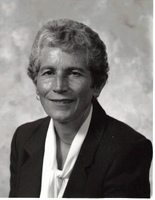 Dr. Betty Atterbury
 Taken from her obituary in the "Portland Press Herald:"
Betty Wilson Atterbury was born in Los Angeles and attended school in New York. She graduated in 1955 from Andrew Jackson High School in Queens and then attended Potsdam State University where she received a Bachelor of Science degree in music in 1958. After attending Hunter College in New York City and earning a master's degree in music, she taught music at the Middle Country School District and received her PhD in music education in 1982. She taught at Appalachian State University in Boone, North Carolina for 3 years. Dr. Atterbury arrived to Maine in 1985 to teach at the University of Southern Maine for 13 years taking a leave of absence in 1997 for health reasons. She wrote several books, one of which focused on mainstreaming exceptional learners and music. She also contributed an article to the “Handbook of Research on Music Teaching and Learning” titled “Research on the Teaching of Elementary General Music” She appeared in “Who's Who of America Women” in 1997. At USM, she was an advisor to the MENC student chapter. Dr Atterbury was the president and research chairwoman for the Maine Music Educators Association, and chairwoman of the “Music Educators Journal” editorial committee. She also had served as an advisory member of the “Bulletin of the Council for Research and Music Education.”
-
 Dr. Eleanor Stubley
 Excepted rom the McGill Reporter:
Eleanor Stubley was an Associate Professor and Associate Dean of Graduate Students in the Schulich School of Music.
Prof. Stubley was born in Brampton, Ontario. She earned her Ph.D at the University of Illinois at Urbana-Champaign, her M. Mus. from Brandon University and her B. Mus. from the University of Toronto. In 1989, she joined McGill, where she taught music education, musicology, and performance.
“Eleanor Stubley was a vital member of the Schulich School of Music community,” said Brenda Ravenscroft, Dean of the faculty. “As Associate Dean for Graduate Studies, she demonstrated on a daily basis profound devotion and fierce advocacy for students, learning, and artistry. An accomplished choral conductor and a thought-provoking scholar, she constantly found unique ways to bridge performance and research, and was an influential mentor for countless graduate students. She was a beloved colleague, who inspired all those around her with her humanity, passion and courage.”
Prof. Stubley conducted ensembles around the world, including the Massey Singers, Elektra, Laapula, the Bach Festival Orchestra, and members of the Canadian Opera Company. Her artistic creations include The Pines of Emily Carr, a performance documentary about the relationship between inspiration and place, and Living Gestures, a multimedia concert series that was performed in Canada and Finland. As the founder and artistic director of Chora Carmina, she helped create innovative collaborations between Quebec musicians and visual artists.
In a message to the McGill community, Principal Suzanne Fortier said that Prof. Stubley “was critically acclaimed as both a scholar and an artist” and “will be greatly missed” in the McGill, Montreal and international music communities of which she was such an important member. Principal Fortier noted Prof. Stubley’s long-term commitment to the Yellow Door Choir, “which used the power of song to raise more than $65,000 for social justice organizations dedicated to tackling such issues as homelessness, women and violence, and illiteracy.” Stubley was the community choir’s music director from 1998 to 2014.
-
 Dr. Marilyn Pflederer Zimmerman
 From the University of Illinois Archives:
Music educator and researcher Marilyn Pflederer Zimmerman was born in Peoria, Illinois. She graduated from Illinois Wesleyan University in 1951, with a Bachelor of Music degree and majors in Piano and Music Education. She earned a Master's of Science degree in 1955 and a Doctor of Education degree in 1963, both from the University of Illinois, and both in Music Education.
Her teaching career began with three years of elementary and junior high school general music instruction in Illinois. She was an instructor at Illinois Wesleyan from 1955-1956. She then served for three years on the music education faculty of Southern Illinois University-Carbondale, before returning to the University of Illinois as an instructor from 1959 to 1964. From 1964 to 1968 she served as associate professor at Northwestern University. On December 16, 1967, she married Vernon Zimmerman and returned to the University of Illinois for three years as visiting associate professor from 1968 to 1971. She also served as visiting associate professor at Illinois State University, The College-Conservatory of Cincinnati, the Pennsylvania State University and the University of Victoria. She served as director of the Music Program at Temple University in 1978-1979 and was the Distinguished Flora Stone Mather visiting professor at Case Western University in 1980-1981. In 1987, she returned to the University of Illinois School of Music as Professor of Music Education, a position she held until 1993.
Marilyn Pflederer Zimmerman's research focused on music education, with emphases in early childhood education and the study of cognitive influences on the musical learning of children. In 1968 she conducted, with Lee Sechrest, an H.E.W. Research Project entitled "How Children Conceptually Organize Musical Sounds." She served as editor of the "Bulletin of the Council for Research in Music Education" and on the editorial review board of "The Quarterly Journal of Music Teaching and Learning." During her research career she published more than fifty articles in various journals in her field. She also participated regularly in the International Society for Music Education. Many of Marilyn Pflederer Zimmerman's writings are available in the book "On Musicality and Milestones : Selected Writings of Marilyn Pflederer Zimmerman with Contributions from the Profession" edited by Mark Robin Campbell and published by the University of Illinois School of Music in 2002.
In 1991 Marilyn Pflederer Zimmerman and her husband established the Vernon and Marilyn Pflederer Zimmerman Foundation, which provided funds for doctoral fellowships, conferences and other scholarships relating to early childhood education and cognitive learning in early music education. The Foundation remains active as of February 2010.
-
Rightists are linked to Laetrile's Lobby
New York Times article on the John Birch Society connections to promoting laetrile.
-
 Palacio de Gobierno
-
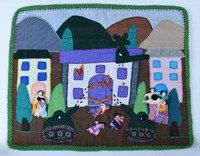 Tanks
Tanks This arpillera features tanks firing at buildings and civilians lying in the streets between the devastation. As the violence breaks out around them, groups of people are seen huddled together, appearing frozen in fear. The bodies' positioning highlights their vulnerability, and the setting instantly conveys chaos and horror. The bodies on the ground imply that the violence is immediate and intimate, impacting common people as opposed to simply troops or political figures, rather than being far-off or abstract. I was first drawn to the artwork because of its clear depiction of suffering, which effectively communicates a strong emotional message without the use of words.
The tanks and helicopter make the whole scene feel overwhelming, like there’s no way out. The way the figures are posed, with their arms up or grouped together, really shows fear and panic. However, the way they are all holding each other hints at themes of community, family and maternal care.
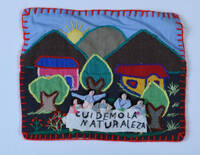
This scene first includes a common theme found in many other arpilleras, the Andes mountains. The Andes mountains are an extremely important part of the recognizable landscape, Chilean culture and natural resources in Chile. This arpillera in particular has a sunless sky made with a grey colored fabric. The sun in arpilleras typically represents hope in such a hopeless time. Without the sun and bright colored sky, the maker of this arpillera wanted to express their feelings of hopelessness and sadness during this time. The scene also depicts a graphic representation of what the military junta did in communities around Chile.
At the same time, I don’t think this is only about violence. It also feels like resistance. These pieces were shared through church groups and even sent to other countries, which helped bring attention to what was happening in Chile. The mountains and simple buildings in the background are reminders of what was happening in normal, everyday places. Overall, I see this arpillera as showing both the fear people lived through and the strength it took to speak out and fight back in creative ways.
-
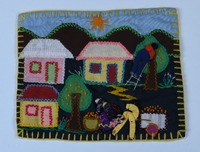 Orange harvest
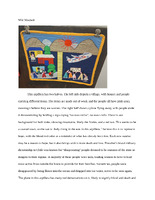
 This arpillera depicts a lovely scene of an orange harvest. Depicted in the arpillera are the Andes mountains, the sun, three houses, two orange trees and three people picking the oranges. There are a variety of types of fabric, such as linen and cotton. Most of the fabric has no pattern except the roof of a house, the wheelbarrow and a dress. The fabric seems to have come from the hem of an embroidered fabric, perhaps a handkerchief or the end of a sleeve. The other patterned fabric used is in the dress of the woman and is likely made of a person’s clothes. Also used is embroidery thread in a multitude of colors. The embroidery thread is used to add flowers, borders, and add small details like the face of a person. Fabric scraps are often used since many arpilleristas did not have the means to buy nicer fabrics.
There are several themes that are also seen in other arpilleras, such as the mountains and the sun. Not only do the Andes ground the scene in a physical location, but they are also symbolically seen as a symbol of strength and stability. The sun is also present, almost in the center of the sky. The sun is seen as a symbol of hope and light, and it shines brightly in this scene. You can almost feel the heat of this summer day and the potential promise of a nice, juicy orange for lunch. We do not know when the arpillera was created, but we know that the arpillerista decided to depict a happy scene rather than the atrocities done by the dictatorship. While there might be many reasons why this was made, the arpillerista is working through a tough memory. This ties into the fact that the audience doesn’t know if the sun is rising or setting in this scene, which can change the feeling of the piece. If the sun is rising, it could signify hope for the future and that things will return to a sense of normalcy. If the sun is setting, then it could signify change. The sun then would be setting over a memory the arpillerista took for granted, an experience or feeling she might never get again. Despite this, the sun being present remains a beacon that hope is still alive.
-
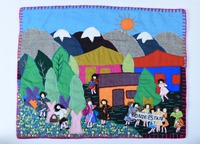 Donde Están?
 The Pinochet dictatorship in Chile was an incredibly violent 17-year period. Thousands of people were tortured, kidnapped, and “disappeared” by this brutal regime. With such widespread, violent means of suppressing political resistance, Chilean women turned to artistic resistance in the form of arpilleras. Arpilleras typically depict military violence or everyday life in Chile. Even the arpilleras that depict everyday life show some aspects of the Pinochet dictatorship; they leave things out, or alter small details to give an uncanny feeling that something isn’t right.
This arpillera only depicts women. While women were targeted by the Pinochet regime, and reported their children being stolen and adopted by military families, men were more commonly targeted which is why there are none in this arpillera. The women in the scene are shown doing many things: dancing, walking in the forest (presumably to collect food), walking around the houses, and holding a sign that says “Donde Están” (where are they). Without context, this almost looks like normal life in Chile; however, we know the women in the scene are grieving the loss of their sons, fathers, brothers, or husbands, while continuing to live and work as if nothing had happened.
All of the women in the arpillera are excellently dressed. The attention to detail on the dresses, all of which are well designed and beautifully posed, is incredibly impressive given that they are only a few inches tall. Similarly, the hair is very well done; despite being on a head the size of a blueberry, every woman has a unique hairstyle that is textured and styled. Femininity was a powerful tool of protest under Pinochet. It allowed women to protest, create arpilleras, and partially protected them from being disappeared. However, it didn’t spare them from the cruelty of disappearances. People who weren’t disappeared still had to live with the grief of losing people they knew.
-
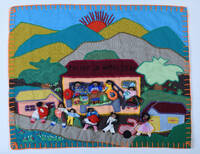 Taller de arpilleras
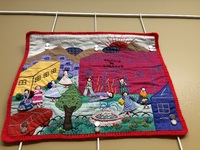
 In this arpillera, the primary theme is community and its transformative power in the changing roles of women. In the “TALLER DE ARPILLERAS” building, women are shown creating arpilleras together. For many women, this may have been their first time feeling community outside of their direct family, a community for learning and empathizing. Through both the art created in each arpillera and the conversations had at workshops, these women were given a space to share in grief (Agosin, 1996) and reflect on their experiences (Bacic, 2015). Additionally, women shown both in the arpillera workshop and on the streets showcase the sense of purpose women worked towards cultivating. Rather than solely being homemakers, women are coming together in this arpillera to make their voices heard. In particular, one could interpret the women marching on the street, arpilleras and materials in hand, as walking towards a formal, contested space, using artistic expression to challenge preconceived notions (Bacic, 2015).
In both the depiction of community and the more minor details of this arpillera, an additional theme of hope emerges. The bright colors of the homes, rising sun, and flowers serve as signs of hope and growth in a country coming out of a period of darkness. Like many arpilleras, this one is set with a backdrop of the Andes Mountains, a range which spans the length of Chile. The sun shining in the center of the Andes seems to communicate that, despite the brutal history of the dictatorship, this region is for all people (Bacic, 2015). Even still, the stroller being pushed by the woman on the right is empty, an artistic choice that is likely no mistake. In an arpillera centered around hope, the harsh reality that many children had disappeared under the dictatorship is still communicated.
-
 Naturaleza