-
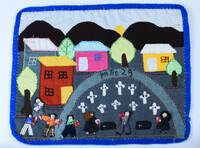 Patio 29
 This arpillera has a deep blue woven border with a dark rendition of the Andes mountains with the sun shining from the background, casting light on what appears to be a funeral, attended solely by women, their clothes often made from scraps of clothing textiles likely from disappeared loved ones. They hold plastic flowers as they surround two coffins in a field of gravestone crosses. Above them sits an arch “Patio 29”, a mass grave site and monument to those who were silenced and disappeared during the military dictatorship. The initials “NN” - “no name” - etched into all grave stones are an echo of the lack of closure surrounding the status of the disappeared.
Patio 29 refers to a memorial site in Santiago where murdered Chileans were buried during the dictatorship. It became an important site for truth-seeking when the country was recovering from Pinochet’s rule and heading toward democracy (Devisser et al., 2014, p. 216). Patio 29 was considered a national symbol for public memory that embodies the fight for truth. It was places like Patio 29 that had impacts on the National Truth and Reconciliation Commission, which worked with limited power to investigate human rights violations after the dictatorship under President Alwyn starting in 1990 (Devisser et al., 2014, p. 222).
This arpillera has many aspects that display the social and geographical context of Chile during the 1973-1990 Pinochet dictatorship. The most obvious feature is the bright colors of fabric used to make the houses in the arpillera. These sewn fabrics had symbolic and emotional meaning, as they belonged to the disappeared or deceased loved ones. Another characteristic of this arpillera is the Andes Mountains and sun in the background. This is sewn into almost every arpillera in Center for Visual Culture’s collection. Arpilleras tend to recreate landscapes controlled by Pinochet, emphasizing details like neighborhood raids, street protests, public squares, and rural landscapes. These areas depicted in the tapestries are not neutral, but rather a representation of political spaces tied to poverty, displacement, or military disturbance (Bacic, 2010, p. 393-394).
-
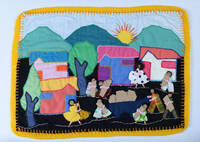 Provisions
 The seemingly cheery scene in this arpillera likely reveals one of the harsher realities of life under Pinochet. Townsfolk are seemingly going about their day, picking up brown packages. The packages are provisions, most likely food or other small necessities. Under the military dictatorship, Chile suffered an economic crisis and arpilleras often represented the survival strategies of poor families in the shantytowns of Santiago. While this arpillera depicts the impact of the economic crisis, it also shows us how the communities mobilized to help one another.
-
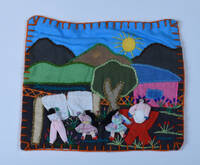 Clothesline
 Pictured here are four people doing laundry outside of their home. Like many arpilleras, the Andes and a shining sun have a prominent position in the scene, and this arpillera has wonderful embroidery work that adds details such as flowers and the fence. While arpilleras in Augustana’s collection depict human rights violations during the military dictatorship, this artist chose to immortalize a happy memory of everyday life in Chile.
-
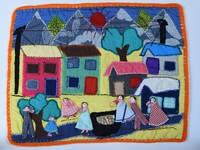 Communal kitchen
 This arpillera shows a group of women and children gathered around what seems to be a large pot of food. This communal meal in the center is especially important and directly ties to what life was like for those in Chile during the Pinochet dictatorship. During this time, many men were disappeared, imprisoned, or killed, leaving women to support their families on their own.
The existing gender roles made it especially difficult for women to take on this responsibility, since they often had very limited access to stable jobs and income. These challenges amplified the need for communities to come together during this time and that is exactly what this arpillera is depicting. It seems that women would come together and create communal kitchens where people in the neighborhood could come together and share food and resources. It highlights not just the struggle to survive under this dictatorship, but also how people relied on each other and the ways communities would come together showing how this collective support became necessary during the dictatorship.
The arpillera also shows that women are the ones primarily taking care of their community. This connects to broader themes of women playing a huge role in resisting the dictatorship, both through organizing their communities and making arpilleras like this one. The background of this arpillera, which includes the Andes Mountains and a bright red sun, is also important. These elements appear in many arpilleras and reflect the geographical features that make up Chile’s identity, but they can also be seen as symbols of hope and resilience even in these difficult conditions.
-
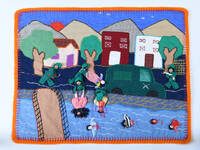 Rio Mapocho
 This is a scene of bodies being tossed into the Mapocho River in Santiago. It caught my attention at first due to the horror and pain it elicited in me, but it also showed how Marjorie Agosín’s writing proved true; women could always tell the stories of the days their family members disappeared or were arrested very clearly. To see the memory and reality of the events illustrated in this way, it made it much more real to me and made me feel the shock, disgust and fear at what they witnessed. The way the arpillerista nestled the dead, bloodied men and women inside of the light blue fabric she used to represent their bodies in the river, as if she was tucking them into bed one last time, similarly touched me and made me understand her sorrow, her grief, and her horror.
The technical methods used reflect the hardship that the arpillerista worked with in her depictions of the disappeared. She works with limited materials– pieces of fabric, perhaps from clothing, perhaps from scraps. She uses white thread to depict the movement of the water carrying the bodies west, green thread to show the prison-like interior of the military van. Thick red thread is used to represent the blood of the women, pouring out and pooling in a
way that makes it unmistakable and impossible to miss. In the background there is the common motif of the Andean mountains, though rather than a bright sun such as in other arpilleras, there is a red sun of dusk and the sky blanketed in blue. There are small embroidered stars visible in the sky, watching, but even they appear to be distancing themselves away in fear. Under this cover of night, men in thick green uniforms took pleasure in their activity. The tiny embroidered smile on one of the military men’s faces as he dangled a woman upside down from her feet over the river, looking down her skirt, made me understand the sadistic cruelty at play here. The man to his left leaned over the woman he also held over the river, but with blood flowing from between her legs. It was more than the military men following orders. The underpinnings of sexism, through depictions of rape and cruelty, were present in the small details that the arpillerista took care in adding. It was, is, harrowing.
But in the end we must remember the strength, the integrity, the courage it took this arpillerista to show this event. Despite the trauma and fear she must have felt, she pushed through, slowly creating this art work, thinking and deciding how to construct every element, weaving everything she felt and thought and loved and hated into the fabric.
(Text by Samara Singer)
-
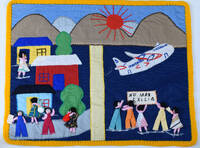 No más exilio
 This arpillera has two halves. On the left of the border, there looks to be a lively neighborhood, with trees, and colorful homes. Several people are gathered outdoors in a public space, suggesting an element of everyday community life. The handmade figures made from fabric and yarn carry bags of goods and look to be involved in a conversation, maybe about work, family care, or current events. This half of the arpillera represents home, belonging, and the social fabric of communities before they were torn apart by kidnappings.
Looking at the right side, the tone shifts dramatically. A plane flies above the heads of characters, away from the neighborhood. Below the plane are a group of people all holding the weight of a sign saying “No más exilio,” meaning “no more exile.” The airplane represents the harsh reality of mass deportations, executions, and exiles from the country. In the Pinochet era, many Chileans who were even slightly suspected of not bending their knee to fascism, such as dissidents, intellectuals, union workers, and ordinary people, were forced to leave the country. This represents the history of the Pinochet regime, using deportations, disappearances, and murders to control the way that the Chilean population lived.
There is one background for both sides, showing the Andes mountains and a red sun. This seems to be a coastal town, so the sun is likely rising in the east in this arpillera. I believe this is to represent hope, with the blood red color as a reminder of what has already been lost. Each new sunrise may be a reason to hope, but it also brings with it more death and loss. Pinochet’s brutal military dictatorship in Chile was known for “disappearing” people deemed to be enemies of the state or dangers to their regime. A majority of these people were men, leading women to have to lead more active lives outside the home to provide for their families. Sometimes, people were disappeared by being flown into the ocean and dropped into the water, never to be seen again. The plane in this arpillera has many red demarcations on it, potentially signifying blood and death and showing how planes took people away into the ocean to dispose of them. The women underneath protesting, I believe, are meant to show how people didn’t submit at the time to the authoritarian regime, and that there was resistance. It also goes against the idea that women are weak or too fearful to do anything, showing women risking their lives for what they believe in.
-
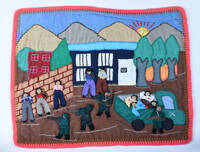 Firing squad
 This arpillera depicts a scene of violence, representing the harsh repression of the Pinochet regime in Chile. The artwork uses repurposed materials such as fabric, yarn, and leather to construct figures of blindfolded individuals and armed soldiers, emphasizing both the humanity of the victims and the harshness of the violence depicted. The image of bodies being transported in a truck and the presence of military forces suggest fear, loss, and political repression. Using recycled materials also gives the piece a strong emotional and symbolic quality, as the fabrics may represent the everyday lives of the people who experienced these events. Some of these materials likely belonged to actual victims or their families, further deepening the emotional connection of the piece.
The background of the arpillera also helps establish its geographic context. The mountains and sun depicted behind the scene represent the Andes Mountains, a major feature of the Chilean landscape. Including these natural elements connects the personal experiences of the people shown in the arpillera to the larger geographic environment in which these events occurred. It may also symbolize how these tragedies were not isolated incidents, but rather widespread across the country.
Overall, this arpillera serves not only as a piece of art but also as a powerful historical and geographic record of the suffering and resilience of communities during a difficult time in Chile’s history. It prompts the viewer to consider how art can serve as both evidence and resistance in times of injustice.
-
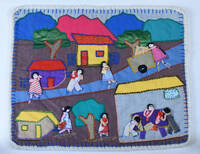 Taller de chalas
-
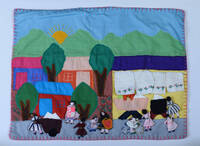 Laundry
-
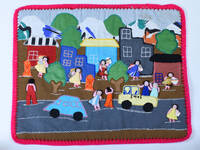 Santiago neighborhood
-
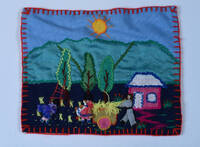 Agriculture
-
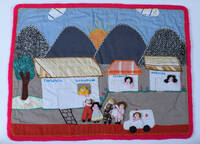 Health clinic
-
 Villa Grimaldi
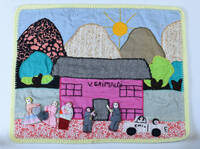
 “Repression at Villa Grimaldi: One of the Concentration Camps”, an arpillera from Augustana’s collection shows a scene outside a place labeled “V. Grimaldi.” At first, it looks kind of simple and almost peaceful. There is a bright pink house, trees, mountains, a sun, and small people standing around in what looks like everyday life. But after looking closer, I realized it is actually showing something much more serious. The “V. Grimaldi” label refers to Villa Grimaldi, which was one of the main detention and torture centers during the dictatorship. Thousands of people were taken there, and many were tortured, killed, or disappeared.
What stood out to me most is the contrast between how the scene looks and what it actually represents. On one hand, the colors are really bright, especially the pink house and green trees, so it almost feels normal or even happy at first glance. On the other hand, knowing what Villa Grimaldi actually was changes everything. Because of this, it shows how violence was happening in places that could still look like regular neighborhoods on the outside. Overall, life in Santiago wasn’t always visibly chaotic, but people were still living with fear, loss, and uncertainty.
Overall, this arpillera shows both everyday life and violence at the same time. At first glance, it looks simple, but in reality, it represents something very heavy. It shows how people tried to keep living while dealing with fear and loss, and how women used sewing to tell stories that otherwise might have been erased. In conclusion, the most important part is how it keeps memory alive. Even though the government tried to hide what happened in places like Villa Grimaldi, these women still found a way to show the truth through fabric.