Analysis of Tanks arpillera
Item
-
Title
-
Analysis of Tanks arpillera
-
Contributor
-
Eli Aldana, Grace Lichthardt, Tyler Marquez, Will Routh, Mia Sturm
-
extracted text
-
1
Grace Lichthardt
Christopher Strunk
Revised Arpillera Analysis
April 10, 2026
Fabric and Thread with a Voice
From 1973 to 1990, Chile was under control of a brutal military dictatorship led by
Augusto Pinochet. Pinochet came to rule after overthrowing President Allende in a military coup
on September 11, 1973. The military junta targeted anyone who they viewed to be in support of
left-wing organizations, as well as intellectuals and students. The junta would kidnap (or
disappear), torture, and kill those who they targeted using extreme physical and mental torture.
Some of the physical torture tactics the junta used were electric shocks to genital areas, sexual
violence, and severe beatings. Some of the mental torture tactics used were isolation, and sensory
manipulation such as blindfolding or contiunal playing of sounds or music.
Pinochet's military junta affected the lives of thousands and thousands of people. Many of
those affected turned to art as a form of expression during these extremely dark times. Women in
Chile began making “Arpilleras” as a form of protest against the military junta, bringing
awareness to what they and their families had to go through. Arpilleras were typically made from
burlap of old potato sacks, scraps from the clothes of those who had disappeared and any other
materials like buttons or beans that the women could afford to use. There is no right or wrong
way to make an arpillera, making it an art form that allowed for any and all women, and Chileans
as a whole to participate in voicing their feelings during the military dictatorship.
�2
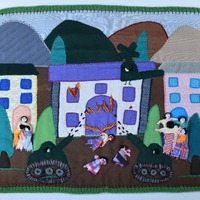
The arpillera that I decided to analyze depicts a graphic scene in a Chilean neighborhood
outside of a group of families houses. This scene first includes a common theme found in many
other arpilleras, the Andes mountains. The Andes mountains are an extremely important part of
the recognizable landscape, Chilean culture and natural resources in Chile. This arpillera in
particular has a sunless sky made with a grey colored fabric. The sun in arpilleras typically
represents hope in such a hopeless time. Without the sun and bright colored sky, the maker of
this arpillera wanted to express their feelings of hopelessness and sadness during this time. The
scene also depicts a graphic representation of what the military junta did in communities around
Chile. The maker of this arpillera made military tanks firing at a house and people in the family,
as well as a helicopter patrolling the area. This arpillera represents the unfortunate reality of what
an encounter with the military junta may look like during the military dictatorship, and the
horrific results of the brutal violence. My favorite part of this arpillera however are the families
embracing one another and keeping those around them as safe and secure as can be. In a time
where nothing was certain, holding onto those close to you was extremely important. The love
that the families feel for one another in this arpillera is easily seen and felt.
Arpilleras are an extremely important art form to this time period that allowed those
affected heavily by the brutal Pinochet military dictatorship to voice their feelings and emotions.
It gave the arpillera makers a community where they could relate to one another and feel
supported during such a dark time. Arpilleras serve not only as a reminder of the brutal history of
Chile during this time, but also as a reminder that there are beautiful ways to give voices to the
voiceless. Ways that create amazing, timeless pieces that we know as Arpilleras.
�

 Tanks
Tanks